




















































REVIEWER: James Tar Tsaaior
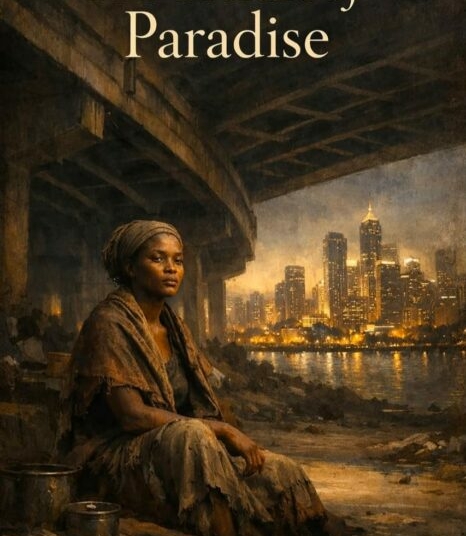
A Portrait of Paradise is a pulsating, telling tale in the tradition of political allegory. It narrates a modern nation-state inextricably entangled in a sticky web of manifold contradictions which gnaws viscerally at its very soul and existence. The novel is largely set in the fictional West African nation of Sofalia, a metaphor for, and epitome, of unrelieved suffering. In it Iyorwuese Harry Hagher skillfully demonstrates how Sofalia’s political elite manipulate the levers of naked power, and anything and everything in-between, to privilege and sustain their affluent, hedonistic, permissive and self-aggrandising lifestyles to the detriment and mutual exclusivity of the Atsan. This is the mass of the oppressed, impoverished and dispossessed population who exist in the peripheries and lowest rungs of the social pyramid and are at the mercy of life’s vicissitudes.
Sofalia is a confirmed, pitiable case of a modern nation-state on the precincts of a yawning precipice. Led by a brood of viperous, treacherous, egocentric, and selfish politicians who have parceled the national patrimony among themselves as fiefdoms or personal estates it is a name which is synonymous with mass poverty, suffering and death. It has, therefore, been plunged into the ever-deepening, abysmal political quagmire as a failed state. Its infrastructure is decrepit, its economy in the doldrums, its social life severely stratified without a middle class and life is ruinously divided like an ever-widening chasm along the extremities of the opulent and the dispossessed.
At the head of its delinquent political elite is President Kila who is on the threshold of ending his second and final term. There is also Senator Kini Mulaake (literally swollen testes) who, through deft political gerrymandering, is expected to succeed Kila. These predatory politicians prey on their citizens particularly young, ambitious women, and truncate their dreams of becoming productive and prosperous citizens. Senator Kini is most notorious in this regard as he wrecks the lives of such women. One victim is the brilliant first class graduate, Aishatu, also known as Queen Aisha, who ends up as a psychiatric case due to crack cocaine abuse. Then there is Queen Akember, the intemperate wife of the brutal terror gang leader Gungun. Gungun himself, a victim of serial political betrayals by Kini, ends up paralysed neck down in a German health facility after surviving a deadly bombing by Sofalia security forces in his isolated Binda Hills cave where he mines precious minerals for Senator Kini and his political cohorts and co-travellers.
In a narrative which eminently qualifies as a political parable, Hagher portrays Senator Kini as a villainous hero whose vaunted ambition to become president of Sofalia miscarries as the combined conspiracy of the West and the two queens, Aisha and Akember, proves fatal and consequential. The senator loses balance in the political quicksand he has plunged himself into and ends up as a guest of the Criminal Court at The Hague for war crimes. The epiphanic moment for him arrives when he confesses in a dramatic monologue his apotheosis as a political pervert who acknowledges the transience of power and the futility of its appurtenances and announces his conversion and redemption.
In this novel, Hagher, a former Nigerian senator, minister, envoy, academic, scholar, and storyteller, masterfully etches on the narrative canvas the motifs of political brigandage, economic sabotage, social savagery, and moral debauchery which animate and mediate politics in an African modern nation-state which bears striking resemblances with his native Nigeria. Hagher, therefore, enjoys the charmed kinship of other African novelists like Chinua Achebe, Ngugi wa Thiong’o, Naguib Mahfouz, Nadine Gordimer, Tayib Saleh, etc. who have ploughed the undulating furrows of social ennui and political corruption ravaging Africa in their creative oeuvre.
The novel’s preoccupation gravitates to the appropriation of the national commonwealth by a parasitic and unproductive political oligarchy, the Ogas (potentates in Nigerian Pidgin English) which institutes social hierarchies that keep the masses perpetually submerged on the margins. The political class illegally mines the rich mineral resources of Sofalia, enriches and ensconces itself in the cocoons of power, funnels the wealth into offshore bank vaults in Western capitals and clandestinely promotes terrorism and banditry to perpetuate the crime and their reign. What should be a true paradise with prodigious endowments is paradoxically and regrettably the very abyss of hell for the citizens. When Sofalia is expecting the high profile state visit of President Barack Obama of the United States of America, the government orders the cleansing or purging of the capital city, Calanana of the pathology of the Atsan class considered the contagion of society. This empty, cosmetic ritual exemplifies the murderous rage against the Atsan, the hoi polloi who are ironically the real creators of wealth but who have been alienated and reduced to crass, crushing poverty. In the end, the state visit is aborted by the contingencies of endemic corruption and egregious human rights abuses by the political elite of Sofalia.
Also on the novel’s narrative agenda is the defining gender calculus which limits and undermines female agency and subjectivity. Patriarchy enacts its visceral energies to dominate, oppress and repress women who also contest phallic power through matriarchal resistance armatures. This gender contestation piths the male political juggernauts led by Senator Kini who represents the patriarchal power integer and the subversive female vanguard under Queens Aisha and Akember. These women are modeled after the archetypal Dahomean Amazons (female warriors who protected the integrity of the empire) and other powerful African/Black women in history. In their attempt to undermine male power and its totalizing assumptions, these two queens combine efforts to counteract patriarchal domination and sexploitation of women in Sofalia through the creative mobilization, conscientization and application of resources of their respective groups, the Atsan and the Gungun Terror Organisation to battle Senator Kini to a virtual standstill. From all indications, it is obvious that the new Sofalia will reckon with the power of women as veritable complementary vectors of positive transformation and indispensable partners in the political and social engineering processes. By privileging female power and ideology, Hagher cultivates the gender inclusivist literary company of female writers like Ama Ata Aidoo, Nawal El Saadawi, Assia Djebar, Chimamanda Adichie, NoViolet Bulawayo, etc.
Like his late compatriot, writer and environmentalist, Ken Saro-Wiwa, Hagher sets his sights on the important issue of nature and the environment and creatively weaves that concern into the novel’s narrative motions. The power of nature over humanity and the imperative for healing and restoration of the delicate balance humanity and threatened ecosystem is foregrounded through the ocean surge which drowns Kepe village on the coast of the Atlantic Ocean. The devastating storm exerts a profound impact on the environment in a time climate change has become a significant issue on the global agenda. It is the storm that throws up Aishatu who is adopted by the mega-billionaire pastor of Paradise Church, Godswill and his delectable wife, Beatrice. The power of religious bigotry and hypocrisy preoccupied with obscene riches and drunk with iniquitous power is underscored through Godswill and Little Jehovah, two of the most consequential religious personages in the novel. Tragedy paradoxically functions as a destructive but also benevolent, redemptive force in the life of Aishatu as she emerges from the storm as a prodigy destined for greatness. This is how Senator Kini meets with Aishatu and this encounter sets up a concatenation of events in the novel’s narrative kinesis which builds up in the climax of frustrating Kini’s presidential bid.
– James Tar TSAAIOR, PhD
Professor of Media and Cultural Communication
Lagos, Nigeria.
& Alexander von Humboldt Experienced Research Fellow
University of Potsdam, Germany.









You must be logged in to post a comment Login