

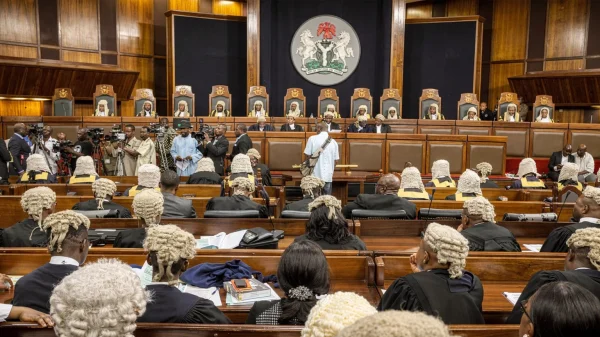







































Ahead of tomorrow’s Supreme Court hearing and with time ticking fast for parties to select candidates, heavyweight politicians in the African Democratic Congress (ADC) are already activating their contingency moves to secure participation in the 2027 general elections and avoid being stranded.
The Independent National Electoral Commission (INEC) fixed party primaries between April 23 and May 30 this year, by which time parties are mandated by law to select candidates through direct primaries or consensus arrangements.
But with the leadership crisis rocking the ADC escalating into a complex legal and political standoff, with three rival factions advancing competing constitutional claims and the party effectively left without a recognised national leadership, fresh reports of alleged behind-the-scenes political engagements and possible realignment between ADC and the Peoples Redemption Party (PRP) have emerged.
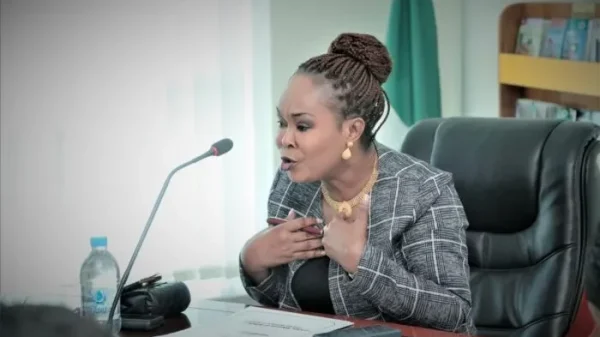
Making a veiled reference to this yesterday, the National Chairman of PRP, Hakeem Baba-Ahmed, said many politicians are showing interest in joining the party ahead of the elections.
Speaking during an interview on Arise TV, he described the PRP as a viable political option and said its doors are open to new members.
“In the last three or four weeks, you will be amazed at how many people have reached out to us and said, ‘We’re coming over to your party,’” he said. According to him, the party is ready to receive anyone willing to join.
“Our doors are open to anybody who wants to come in, either on their own or because the system has blocked and virtually destroyed their party,” he said. Baba-Ahmed added that the party’s role in the coming months would be much bigger than before. He noted that the growing interest shows confidence in the PRP.
He explained that those coming into the party are not doing so out of desperation but because of its long-standing values. “They are not just coming as political refugees. They are coming because we are a party of principles,” he said, describing the party as one of the oldest in the country.
Baba-Ahmed, who was a former special adviser on political matters to Vice-President Kashim Shettima, also said President Bola Tinubu is disconnected from the realities confronting Nigerians. The president had said Nigerians who do not see progress under his administration are either biased or unable to recognise development.
Last week, Tinubu hit back at the opposition, insisting that those who fail to recognise the administration’s efforts would require prescription glasses. “If they don’t want to see the hope, we shall lend them ‘jigi-bola’ eyeglasses,” the president said.
ALSO READ:
Baba-Ahmed said Tinubu’s comments raised concerns about the government’s awareness of prevailing economic and security challenges.
“There is no way you can live in this country, see the level of poverty and unaccountability, and still expect Nigerians to applaud your performance,” he said.
Also, Special Adviser to President Tinubu on Policy Communication, Daniel Bwala, has said those who failed to “privatise” the ADC are planning on doing the same with the PRP. He posted on X, “After failed privatised ADC, I am hearing they are planning to go and privatise PRP and run on that platform. Privatisation without due process equals disintegration.”
Bwala, however, failed to mention the names of those his words target. The presidential spokesperson recently accused the ADC of importing foreign interference into Nigeria’s elections. In a post on X, Bwala mocked the ADC’s lack of preparation ahead of the 2027 general elections, a point he argues should be obvious to foreign governments with embassies in Nigeria.
However, the embattled ADC has strongly dismissed the claims. In a statement issued yesterday, ADC spokesperson, Bolaji Abdullahi, described the report as false, insisting that the party’s coalition leadership is not engaged in any such discussions.
The party maintained that its focus remains on challenging what it described as “illegal action” taken against its leadership by INEC and “agents of the ruling party.” According to the ADC, pursuing the legal route is critical to protecting the rule of law and preserving Nigeria’s multiparty democracy.
While acknowledging openness to broader opposition collaboration, the party stressed that it has no intention of abandoning its platform. “Any suggestion that we are considering abandoning the ADC is pre-emptive and speculative, and should be ignored,” Abdullahi said.
He added that despite concerns over what the party called the “bastardisation of democratic institutions,” the ADC remains confident that the judiciary will uphold justice in the matter. The party reiterated its commitment to its current legal battle, describing it as central to defending democratic principles in the country.
In what some political watchers have portend as a possible disengagement from the ADC should the leadership crisis muddle up preparations for the elections, supporters of former Anambra State Governor, Peter Obi, and ex-Kano State Governor, Rabiu Kwankwaso, have launched a new political pressure group, the Obi–Kwankwaso (OK) Movement, as permutations intensify ahead of the ADC presidential primary.
The group, which announced its emergence in Abuja on Monday, said it has already established structures across the 36 states and the Federal Capital Territory, and has appointed state and zonal coordinators to drive its mobilisation.
National Publicity Secretary of the movement, Justin Ijeh, disclosed this in a statement issued in Abuja, describing the initiative as a coalition of political forces comprising the Obidient Movement, Kwankwasiyya, the New Nigeria People’s Party (NNPP), and the ADC.
The development signals a fresh layer of realignment within the opposition coalition, amid growing uncertainty over who will clinch the ADC presidential ticket ahead of the 2027 general elections. The OK Movement appears to mirror the structure and grassroots appeal of the Obidient Movement, whose organic and youth-driven mobilisation reshaped Nigeria’s political landscape during the 2023 elections. The movement also expressed concerns that Nigeria stands at a defining crossroads and requires urgent interventions by all patriotic citizens.
But Sunday Dare, Special Adviser to President Tinubu on Media and Public Communication, has questioned Obi’s leadership capacity, saying the former Anambra governor failed to manage internal crises within his party.
Speaking during an interview on African Independent Television (AIT) on Monday, Dare criticised Obi’s role in the Labour Party (LP), arguing that he neither founded nor effectively controlled the party.
“Look at the history of the Labour Party. Did Obi form the Labour Party? Was he even in control of the Labour Party?” Dare queried.
He accused Obi of lacking commitment to party-building, adding that the former presidential candidate “has the tendency of just strolling into a party and strolling out.
When the crisis of Labour started almost two and a half years back, we witnessed it. Did Obi even play a central role?” he asked.
“We saw it play out in the open, and rather than fix his party, he jumped ship and moved to another party. Is that the person you want to entrust the fate of 230 million people to? You cannot fix your party.”
Dare also dismissed allegations linking the presidency to the crisis within the ADC, insisting that the matter is purely internal and subject to judicial resolution. “ADC was hijacked. The original owners of ADC are back to say, ‘we want our party back,’ and again, in what way is the president responsible for the crisis in the ADC?” he said.
The presidential aide emphasised that ongoing legal processes should be allowed to take their course, urging parties involved to refrain from public outcry and agitation.
Meanwhile, the ruling All Progressives Congress (APC) has formally unveiled its timetable and schedule of activities for the 2027 general elections, setting the stage for what is expected to be an early and intense round of political manoeuvring.
According to the timetable, the sale of nomination and expression of interest forms will run from April 25 to May 2, 2026, at the party’s National Secretariat.
The party fixed its presidential primary for May 15–16, 2026, while other primaries will follow in quick succession: House of Representatives on May 18, Senate on May 20, State Houses of Assembly on May 21, and governorship primaries on May 23.
In a move likely to spark debate, the APC pegged its presidential nomination form at N100 million, with governorship forms costing N50 million. Aspirants for the Senate will pay N20 million, House of Representatives N10 million, and State Assembly N6 million.
The timetable, signed by the party’s National Organising Secretary, Sulaiman Muhammad Argungu, also outlines timelines for screening and appeals, underscoring the party’s push to streamline its internal processes ahead of the polls.
In a statement issued by its National Publicity Secretary, Felix Morka, the APC said the early release of the schedule reflects its commitment to transparent and credible primaries, while giving aspirants ample time for consultations and mobilisation.
The announcement signals the formal kick-off of APC’s 2027 election cycle, with political activities expected to ramp up nationwide in the coming weeks.
The Guardian








You must be logged in to post a comment Login