





















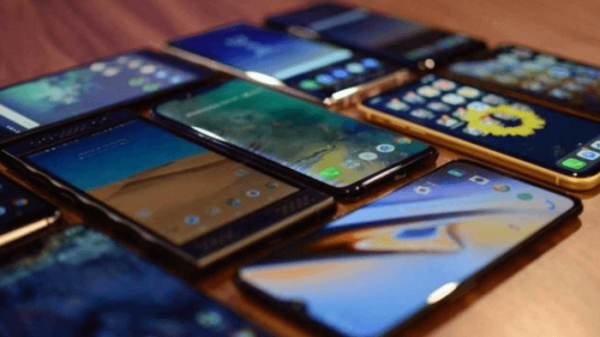





























When Nigeria developed its digital economy programme, success was envisioned on the backdrop of a robust smartphone market — the largest in West Africa and one of the fastest-growing on the continent. But unlocking the initiative’s full potential now faces threats as dealers anticipate a price squeeze that could make mobile devices unaffordable for many Nigerians.
Several smartphone dealers have disclosed that a significant price surge could hit the market in the coming weeks, driving the cost of budget, entry-level devices up by at least 15 percent.
This means Nigerian consumers may pay significantly more for their next smartphones, a development that could mar the federal government’s target of 70 percent internet penetration by 2027 as it doubles down on investments in broadband, 5G, and digital platforms to boost connectivity.
Smartphone penetration reportedly stood at 59 percent in urban areas of Nigeria and 26 percent in rural communities in 2023.
CHIP CRUNCH DRIVING UP MANUFACTURING COST
Analysts tracking global supply chains have warned that a fresh wave of chip shortage pressures, driven largely by the accelerating artificial intelligence (AI) boom, has pushed smartphone manufacturing costs to a three-year high.
Oluseyi Akindeinde, founder of Hyperspace & NeuRaL AI, said the envisaged hike is not speculative.
“The rumours of smartphone price hikes are grounded in reality,” he said.
Akindeinde said artificial intelligence companies such as OpenAI, Google, and Nvidia are consuming massive volumes of advanced memory chips for data centres, creating supply constraints for consumer electronics manufacturers.
The founder estimated that prices could rise by about 8 percent globally and between 15 and 20 percent for budget devices in 2026.
A price surge within the projected range, he said, could see a N60,000 entry-level device rise to between N72,000 and N84,000 if the higher-end projections materialise.
Ben Ekechukwu, the managing director of DisTech in Lagos, attributed the anticipated increase to the high cost and scarcity of chips.
“Most manufacturers are now preferring to supply large foreign companies, especially those involved in artificial intelligence. So because of that, there is a very high demand for chips,” he said.
“And most mobile phone companies are not getting enough, and it’s pushing the prices up.”
Ekechukwu said the effect may begin to “crystallise” as early as March, with increases projected between 10 and 20 percent.
He added that the chip situation will not affect smartphones alone, but also computers and other electronic devices.
EXCHANGE RATE, VAT ALSO IN FOCUS
Nigeria’s electronics ecosystem remains largely import-dependent, with limited local assembly capacity and virtually no semiconductor manufacturing. This exposes the country to global supply shocks.
Olakunle Oladipupo, a distributor in Abuja, said foreign exchange (FX) rate movements remain a key determinant of pricing.
“It depends on the exchange rates,” he said when asked about the likelihood of an increase.
He acknowledged that a weaker naira would translate into higher retail prices across brands, especially Android and feature phones.
Distributors also said the value-added tax (VAT) at 7.5 percent could add an additional layer of cost, although some said the old pricing structure is still being maintained pending further clarity.
Ozidigbe Victor, another distributor, explained that “a 7.5 percent VAT automatically adds N7,500 to a N100,000 device — before distributor margins”, with higher-end models seeing steeper increases.
“Some have started already,” he said, adding that others may adjust prices as new stock arrives.
SUB-N139,000 SMARTPHONE ERA TO END
Substantiating the positions of the experts, a recent report by the International Data Corporation (IDC) warned that the average selling price of smartphones will climb 14 percent to an all-time high of $523 (N728,539).
The report also expects the era of sub-$100 (N139,300) smartphones to effectively end as production costs surge.
The IDC forecasts that global smartphone shipments will drop by 12.9 percent in 2026 to 1.12 billion units — the lowest level in over a decade.
IDC added that smaller manufacturers relying on Google’s Android ecosystem are likely to bear the brunt, while industry leaders such as Apple and Samsung are expected to weather the disruption and potentially expand their market share.
IMPLICATIONS FOR NIGERIANS AND NIGERIA
In addition to revised phone price tags, if forecasts hold, Nigeria’s young population may face significant constraints as access to affordable smartphones is central to the expanding technology workforce and digital economy.
Already, big telecoms firms in Nigeria have lamented the implications of unaffordable 5G-enabled smartphones.
“Rolling out the network (5G) is important, but it’s just as crucial to ensure that consumers have access to 5G-enabled phones,” Dinesh Balsingh, chief executive officer (CEO) of Airtel, said in 2025.
Akindeinde also warned that rising device and service costs could reverse gains recorded in the smartphone market, which rebounded by 29 percent in the third quarter of 2025 following relative naira stabilisation.
“Nigeria risks achieving 70% broadband coverage with only 40% effective access, creating economic exclusion rather than digital inclusion,” he said.
While infrastructure investments have continued, with MTN Nigeria reportedly investing about N1 trillion in 2025, the tech expert argued that device affordability may become the “binding constraint”.
He urged the federal government to renew zero-import duties on smartphones, expand incentives for local assembly, introduce device-financing partnerships with telecoms operators, and optimise critical services for USSD to accommodate users priced out of the smartphone market.
The Cable