


















































…FMBN is a safe net for Nigerian workers to acquire housing – NSITF
In the continuous effort to improve on the welfare of Nigerian workers, the Federal Mortgage Bank of Nigeria (FMBN) and the Nigeria Social Insurance Trust Fund (NSITF) have begun discussions on a new framework for collaboration aimed at expanding access to affordable housing for workers.
The talks took place when FMBN’s Management, led by the Managing Director/Chief Executive, Shehu Usman Osidi, FCIB, FICA, FCNA, received a delegation from NSITF, led by the Executive Director, Finance and Investment, Mr. Olufemi S. Ayodele, at the Bank’s Head Office in Abuja on Wednesday, March 11, 2026.
Welcoming the delegation, Osidi described the visit as a demonstration of the longstanding relationship between both institutions and an opportunity to strengthen cooperation in advancing the welfare of Nigerian workers.
He noted that both institutions share a historical relationship dating back to the early structure of FMBN, when NSITF was originally considered among the organisations envisioned to hold equity in the Bank due to its role in safeguarding the welfare and long-term interests of Nigerian workers.
He however, explained that institutional developments over the years, including the enactment of the Employees’ Compensation Act, have reshaped NSITF’s mandate, transitioning the Fund into a specialised social insurance institution focused on workplace compensation, occupational safety and employee welfare protection.
In a similar vein, he noted that FMBN was also in the process of consolidating its ownership structure with the Federal Government as the sole shareholder for its broader recapitalization to the tune of 750 Billion Naira and strengthening its capacity to deliver on its national housing mandate.
Despite these changes, the FMBN Chief Executive stressed that opportunities for partnership between both organisations remain strong.
He projected that collaboration between FMBN and NSITF could explore structured housing schemes for employees, cooperative housing initiatives and tailored mortgage access for workers within organisations participating in the Employees’ Compensation Scheme.
According to him, such partnerships would complement existing social protection programmes while expanding access to affordable housing, similar to the partnership structure deployed in the Renewed Hope Project in Karsana, Abuja where FMBN is providing a N100 Billion Naira Offtaker Guarantee in support of the project.
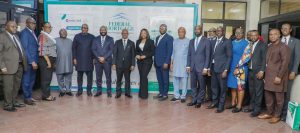
Osidi emphasised that addressing Nigeria’s housing deficit requires deliberate institutional collaboration, affirming that FMBN remains committed to working with relevant stakeholders to deliver sustainable housing solutions for Nigerian workers and low- and middle-income households across the country.
He added that such collaboration aligns with and gives effect to President Bola Ahmed Tinubu’s desire to turn Nigeria into a major construction site, as expressed during the groundbreaking ceremony of 3,112 housing units of the Renewed Hope Cities and Estates Project in Karsana, Abuja.
On his part, Mr. Ayodele, who represented the the Managing Director/Chief Executive of NSITF, Barr. Oluwaseun Faleye, highlighted the significance of the visit to strengthening collaboration between both institutions in ways that would directly benefit Nigerian workers.
Describing FMBN as a safe net for Nigerian workers to acquire housing, he noted that workers contribute to both the National Housing Fund (NHF) and NSITF Schemes, creating an opportunity for the two institutions to work together with developers to expand housing access.
He affirmed that such collaboration aligns with the housing objectives of the Renewed Hope Agenda and assured that NSITF would continue discussions with FMBN to advance the initiative.
The meeting had in attendance FMBN’s Directors of Finance and Corporate Services, Mr. Ibidapo Odojukan, and Business Development and Portfolio Management, Mrs. Chinenye Chinedu Anosike, as well as top management staff of the Bank, and ended with a resolution to constitute a Joint Technical Committee to drive the initiative.