




































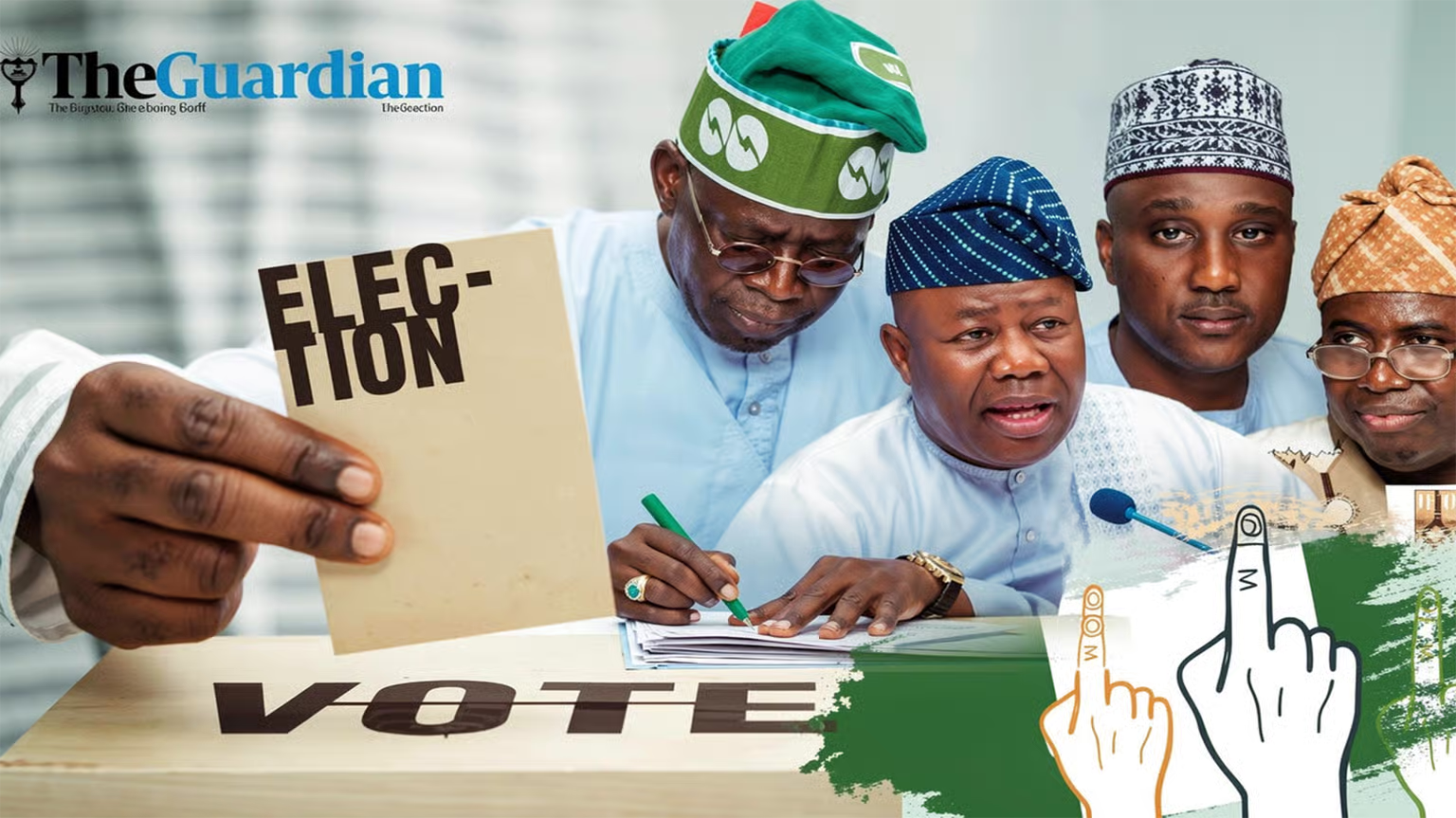
As Nigeria inches towards the 2027 general elections, debates over electoral credibility have returned to the forefront, largely driven by unaddressed gaps in the Electoral Act 2022.
Specifically, stakeholders are concerned about the unresolved ambiguities around the electronic transmission (e-transmission) of results, the effective prosecution of electoral offenders despite the culture of impunity and vote-buying, and the independence of the umpire.
Concerned parties hinged the credibility of the 2027 general election on a stronger Electoral Act and a better-prepared Independent National Electoral Commission (INEC), though disturbed by the parliament’s noncommittal in resolving lingering ambiguities.
Although the Electoral Act was widely applauded as a bold reform after years of advocacy by civil society groups, opposition leaders and election observers, the 2023 general elections exposed major weaknesses that now threaten to shape the next electoral cycle unless urgently addressed.
At the heart of the concern is a growing consensus among political stakeholders, election observers and legal experts that the law, though progressive in intent, remains vulnerable to elite manipulation, institutional discretion and weak enforcement.
With the ongoing realignment of political forces ahead of 2027, the stakes for reforming the Electoral Act have become inseparable from Nigeria’s broader struggle to deepen democratic accountability.
Electronic transmission of results
Among the most contentious issues Nigerians want revisited is the ambiguity in the use of technology, particularly the electronic transmission of results.
Sections 50 and 60 of the Act permit the use of electronic devices for accreditation and result collation, but stop short of making real-time electronic transmission mandatory across all elections.
This ambiguity proved consequential in 2023. While the Bimodal Voter Accreditation System (BVAS) performed relatively well in voter verification, the failure to consistently upload presidential election results to the INEC Result Viewing Portal (IReV) triggered widespread suspicion, legal disputes and public outrage.
INEC’s explanation of “technical glitches” exposed a fundamental flaw in the law, which grants the commission excessive discretion over the deployment of technology without clear safeguards or penalties for non-compliance.
Opposition figures argue that unless the Electoral Act is amended to make electronic transmission compulsory, with clearly defined timelines, redundancy systems and sanctions, the next general elections may continue to be shaped by administrative excuses rather than legal certainty. In a political environment where margins of victory are often narrow, such loopholes carry far-reaching implications for power retention and succession.
A former member of the Fourth National Assembly who represented Khana/Gokana Constituency in Rivers State, Bernard Mikko, said that while no law can be perfect, the real challenge lies with those who operate it.
Electoral offences and culture of impunity
Perhaps the most glaring weakness identified by stakeholders is the enforcement of sanctions against electoral offenders.
Despite extensive provisions on electoral offences in Sections 121 to 129 of the Act, prosecution remains rare and selective. Vote-buying, voter intimidation, result falsification and electoral violence continue to occur with minimal consequences for perpetrators.
Observers note that the core problem is structural. INEC is saddled with the dual responsibility of organising elections and prosecuting offences, a burden widely regarded as unrealistic.
Mikko said that as a result, cases are either abandoned or poorly pursued, reinforcing a culture of impunity that emboldens political actors.
He stressed that the proposed establishment of an independent Electoral Offences Commission (EOC) must become a legislative priority before 2027.
According to him, such a body would professionalise investigation and prosecution, deter malpractice and shift elections away from brute force and financial inducement towards genuine voter choice.
Media reports indicate that about 781 electoral offenders were arrested nationwide during the 2023 general elections, yet only a fraction of these cases have progressed meaningfully through the justice system.
Figures from the Nigeria Police Force (NPF) show that the arrests arose from 489 recorded infractions across the presidential, National Assembly, governorship and state assembly elections. Of this number, 203 suspects were arrested during the February 25 presidential poll, while 578 were picked up during the March 18 governorship elections.
INEC later disclosed that it compiled 1,076 case files on alleged offenders across 35 states in collaboration with the police and the Nigerian Bar Association. States with high numbers of cases included Ebonyi, Edo, Anambra, Kano, Rivers and Osun, involving offences ranging from vote-buying and ballot box snatching to violence and impersonation.
However, as of early 2025, INEC said only about 774 offenders were actively being prosecuted nationwide, with just a handful of convictions recorded. The slow pace of prosecution has renewed calls for an Electoral Offences Commission, as stakeholders warn that weak accountability continues to fuel impunity ahead of 2027.
Money politics and vote-buying crisis
Another area demanding urgent amendment is campaign finance regulation. Although the Act prescribes spending limits for candidates and political parties, enforcement has remained weak, allowing money politics to flourish unchecked.
The 2023 elections witnessed an unprecedented normalisation of vote-buying, with political operatives allegedly deploying cash transfers, food items and digital inducements at polling units. The law’s narrow definition of vote-buying and INEC’s limited monitoring capacity have rendered existing provisions largely ineffective.
Reform advocates are pushing for tougher penalties, improved financial disclosure requirements and the deployment of digital tracking mechanisms to monitor campaign spending. Some have also called for candidate disqualification in egregious cases, arguing that fines alone are insufficient deterrents for wealthy political actors.
In a polity where godfatherism and patronage networks dominate party structures, failure to curb money politics could further marginalise credible but less affluent candidates ahead of 2027.
Party primaries and internal democracy
Section 84 of the Electoral Act was designed to strengthen internal party democracy by regulating primaries and candidate selection. Yet experience has shown that political parties continue to circumvent these provisions through manipulated delegate lists, forced consensus arrangements and arbitrary substitutions.
The fallout has been a surge in pre-election litigation, with courts inundated by disputes arising from flawed primaries. These internal crises often spill into the general elections, weakening party cohesion and confusing voters.
Spokesman of pan-Yoruba socio-political group Afenifere, Jare Ajayi, argued that the Act requires clearer standards for internal democracy, stronger sanctions against parties—not just candidates—and stricter timelines to prevent endless judicial intervention. In an era marked by defections and coalition-building, internal party reform has become central to electoral stability.
Elder statesman Tanko Yakassai has urged Nigerians dissatisfied with the Electoral Act to seek judicial intervention rather than wait for the National Assembly, arguing that lawmakers are unlikely to reform an Act that benefits them.
Yakassai said expecting the present Senate and House of Representatives to amend the law in ways that undermine their political interests would be unrealistic. While noting that nothing is impossible where political will exists, he expressed doubt that such resolve is present.
“They are the greatest beneficiaries of the present Electoral Act. Anyone who identifies grey areas should approach the courts. Once the courts make pronouncements, such decisions become binding on INEC,” he said.
Similarly, former Senate Minority Leader and former Minister of Health, Olorunnimbe Mamora, said credible elections in 2027 would depend on urgent amendments to key sections of the Act. He identified weaknesses across the pre-election, election-day and post-election processes, noting that many electoral victories are often secured through litigation rather than voter choice.
Mamora called for the compulsory electronic transmission of results, the resolution of all pre-election matters before the general polls, and the swift prosecution of electoral offenders. “A bill can be passed within a week if the political will is there,” he said.
President of the Middle Belt Forum, Pogu Bitrus, observed that the Act vests excessive powers in INEC, making the commission overstretched and vulnerable to manipulation. He advocated compulsory electronic transmission, harmonisation of off-cycle elections and sustained pressure on lawmakers to act before 2027.
National Secretary of the Social Democratic Party (SDP), Olu Agunloye, also said reforms should prioritise electronic transmission and stricter enforcement of campaign finance rules, urging greater transparency and the removal of some responsibilities from INEC to enhance efficiency.
Mikko called for the provision of an independent candidate in the Electoral Act ahead of 2027. He said this is important to curb discrepancies within the political parties.
The Afenifere spokesman also called for a combination of attitudinal change, stronger institutions and strict enforcement of punitive sanctions to curb electoral malpractices in Nigeria.
The group expressed support for ongoing amendments to the Electoral Act but stressed that credible elections depend largely on the willingness of politicians and stakeholders to comply with the rules rather than seek ways to circumvent them.
Ajayi recalled that INEC had proposed 142 reforms to improve the electoral process, including 86 administrative measures, 48 actions requiring stakeholder collaboration and eight needing legislative intervention.
Key amendments identified include expanding voter eligibility to Nigerians in the diaspora and inmates, and introducing alternative forms of voter identification such as electronic voter cards, driver’s licences, passports and NIN, to reduce voter suppression and PVC-related rigging.
Afenifere also advocated stiff sanctions, including long-term bans, for electoral offenders.
The group proposed holding elections 185 days before the end of an incumbent’s tenure to allow court cases to be resolved before the incumbent is sworn in. It further called for the establishment of an Electoral Offences Commission, stronger powers for INEC, reduced nomination fees, the introduction of independent candidacy, real-time transmission of results and a more responsive judiciary that prioritises substance over technicalities.
Meanwhile, credible sources in both the legislature and INEC disclosed yesterday that deliberations on far-reaching amendments to the Electoral Act 2022 will be fast-tracked immediately after the National Assembly resumes later in January, expectedly on the 27th of this month.
The amendments, being processed under the proposed Electoral Bill 2025, are intended to amend and effectively replace the current Electoral Act in order to plug gaps exposed during the 2023 general elections and strengthen Nigeria’s electoral framework ahead of future polls.
A senior National Assembly source revealed that the bill has already scaled second reading in the Senate and is presently before the Senate Committee on Electoral Matters for clause-by-clause consideration and public hearing. According to the source, legislative focus was temporarily shifted last year because of deliberations on the 2026 Appropriation Bill, but assured that the electoral reforms would take priority once plenary resumes later this month.
“The House of Representatives has largely completed work on its own version of the bill. What remains is harmonisation with the Senate, which will commence as soon as both chambers resume,” the source said.
The proposed amendments are aimed at resolving operational ambiguities, strengthening enforcement mechanisms and modernising Nigeria’s electoral processes. Central to the reforms is the push for clearer legal backing for electronic voting and the electronic transmission of results, in a bid to end disputes that trailed the interpretation of existing provisions during the last general election.
The bill also provides for early voting for essential workers, including security personnel and election officials, to curb disenfranchisement. Lawmakers are further considering an expansion of voter identification options to include the National Identification Number (NIN) and international passports as alternatives to the Permanent Voter Card (PVC), a move expected to ease logistical challenges and broaden participation.
ALSO READ:
Other key provisions include diaspora voting, subject to conditions to be set by INEC, as well as enhanced financial and operational autonomy for the electoral umpire, particularly in the timely release of election funds.
To address long-standing concerns over weak enforcement of electoral laws, the bill proposes the establishment of an Electoral Offences Commission with powers to investigate and prosecute violations. It also recommends stiffer penalties for offences such as vote-buying, voter intimidation and electoral violence.
The amendments further seek to clearly define the roles of security agencies during elections to minimise interference and conflicting directives, while tightening regulations governing party primaries to strengthen internal democracy and reduce post-election litigation.
Dismissing fears in some quarters that lawmakers may drag their feet on the reforms, the source assured that the amendment process would be concluded before the end of February.
“Most of the groundwork has been completed. Once the National Assembly resumes later in January, the conference committee of the Senate and House of Representatives will be constituted to harmonise the amendments before final passage and transmission to the President for assent,” the source said.