
































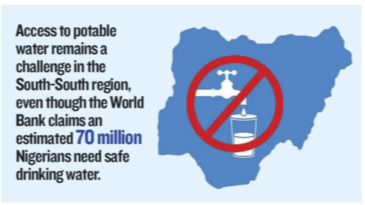
Despite the Federal Government’s assurance to prioritise water provision for the country, states in the South-South region are still plagued with a serious lack of access to potable water, raising concerns among stakeholders and citizens.
Reports confirm that contaminated water from open sources has led to outbreaks of waterborne diseases in several communities and sundry health challenges.
Across the country, the scarcity of clean, safe, and accessible water remains a persistent challenge that has long undermined public health, food security, and sustainable development.
It was in response to this that the Federal Government, through its Renewed Hope Agenda, has rolled out a nationwide water development initiative, working in partnership with state governments to deliver critical water supply and irrigation infrastructure. While several states in the North and parts of the Federal Capital Territory have already benefited from some major schemes that have been commissioned, the situation in the South-South region has largely remained a sad tale.
In states like Akwa Ibom State, federal efforts are reflected in large-scale projects such as the Nkari Dam, currently 55 per cent completed, and the Itu Irrigation Project, which aims to open up 2,000 hectares of land for year-round farming and water management. Both projects underscore the strategic importance of water infrastructure not only for domestic use, but also for agriculture, rural livelihoods, and climate resilience in a region frequently impacted by flooding and seasonal water stress.
However, apart from this solo effort, no fully commissioned federal water scheme has been recorded in the South-South under the current administration, a development that has raised concerns among stakeholders, especially as the Federal Ministry of Water Resources and Sanitation has set an ambitious target to complete and commission at least 11 additional projects nationwide by the end of 2025.
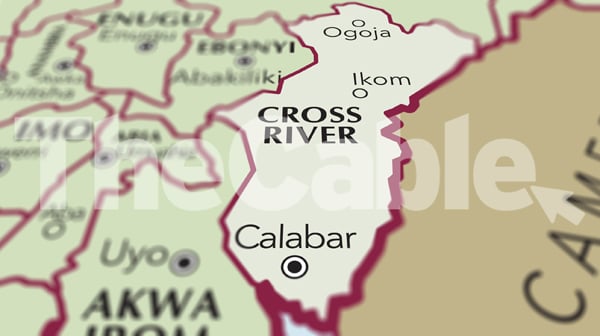
Residents of Cross River State are among the estimated 63 million Nigerians who are without access to improved water sources—a staggering 33 per cent of the country’s population, according to the United Nations Children’s Fund (UNICEF) and the National Bureau of Statistics.
Even though about 70 per cent of Cross Riverians reportedly have some access to water, only nine litres per person per day is available, far below the minimum recommended for basic water services.
Several federal water projects in the state have been abandoned over the years, leaving communities without access to clean water and livelihoods under threat.
Among the abandoned projects is a N13.5 million borehole project in Ifako Okoyong, Odukpani Local Council, which remains incomplete despite its critical importance to the community.
Similarly, the N1.16 billion Obudu Dam Rehabilitation Project, intended to provide water supply and recreational opportunities, has been stalled, even though the state government reportedly accessed funds for its revival. Across the Southern Senatorial District, various other water schemes lie in limbo, with unfinished infrastructure forcing residents to rely on unsafe, contaminated water sources.
Communities in the state, who have continued to struggle with the lack of potable water, often resort to streams and other unreliable sources that expose them to waterborne diseases such as cholera and diarrhoea.
For residents like Caroline Okon of Ifako Okoyong, the daily search for water is fraught with frustration. “We trek several kilometres to a local stream for drinking and cooking water,” she said, adding: “When the streams dry up during the dry season, access becomes very difficult. You have to wake up very early to fetch clean water at the stream.”
In the Calabar Municipality Local Council, Ekpenyong Asuquo shares a similar story of hardship. He wakes up daily at 6 a.m. to buy water from a private vendor miles away, spending about N300 each day on six 20-litre kegs for his household, an expense that amounts to nearly N9,300 monthly, underscoring the economic burden water scarcity imposes on vulnerable families.
Teachers and community leaders also feel the impact. Martins Amunike, a teacher at St. Patrick Primary School in Ifako Okoyong, noted that many children arrive in school late or exhausted because of the long trek to fetch water before school. “Some children even sleep off in class due to exhaustion,” he said, highlighting how water scarcity affects education.
Traditional leader, Chief Paul Effiom, paints a grim picture of daily life: “To get water, you have to walk several kilometres, which is very challenging. Besides water, we lack electricity, health centres, and good schooling facilities. It’s a daily struggle.”
Despite these challenges, federal intervention plans aimed at providing access to potable water in these communities have been marred by mismanagement and abandonment. Millions of naira have been budgeted for such projects, but many have been awarded to contractors or companies that abandon them shortly after commencement, leaving the community’s needs unmet.
Providing some perspectives on the situation, the Chief Geologist at the Cross River Ministry of Water Resources, Mr. Felix Irek said: “Actually, there are some federal government projects, but you need to specify because there are many interventions, with some coming through as constituency projects, others through the African Development Bank (AFDB), and the World Bank, and the federal government decides which to fund. For now, all the ones we have applied for, about three, have not come through yet, apart from one NGO project. We are still waiting for others to start, such as those under the Shore Wash and Key Wash initiatives.”
Mr Irek’s insights underscore the complex web of funding and implementation channels, as well as the delays and uncertainties that plague water project rollouts in the region.
In Rivers State, public water supply is almost zero, as the public water scheme has collapsed. It was fairly better under the military regime, but since the transition to the civilian regime, it has become worse.
The administrations of former Governor Peter Odili and Chibuike Amaechi tried to revive it but failed. Presently, there are water stations in Port Harcourt that have not been functional for the last decade. They include the Gborokiri Water Station close to Enitonia High School, as well as the Bernard Car Water Station.
Both former governor Nyesom Wike and suspended Governor Siminalyi Fubara did not make any attempt to resuscitate all the ailing water projects in the state, thereby leaving residents to generate their own water.
Paradoxically, the state’s annual audited budget expenditure has allocations going into the Ministry of Water Resources and the rural water improvement unit, yet the rural water agency, which is moribund, still receives allocations.
When the water challenge in the state got exacerbated, the state government supplied water to residents through water storage tanks, but that lasted only for a few months. Consequently, the growing water demand pushed communities to resort to the consumption and use of polluted water from rivers.
The preponderance of polluted water being consumed by residents of the state was, a few years ago, reflected in a Journal of Environmental Analytical Chemistry, which detailed how water samples were collected from 10 functional boreholes in Eleme, and standard techniques were used to test them at Fugro International Laboratory, Port Harcourt. The research showed that all the water contained chemicals, and consequently, it was unfit for drinking.
A similar research was carried out by the Kabetkache Women Development and Resource Centre, where 10 women from Eleme were asked to bring water from their various homes. Yet again, the collected water was tested, and the results were unfavourable.
A resident and chairman of the Civil Liberties Association, Sunny Dada, shares his experience, “For over 10 years, we have not accessed the public water supply. I have boreholes in my house, but I still don’t have drinking water due to the location. At the Gborokiri New Road area, you can’t drill for drinking water, so we go several kilometres to connect a pipe to the house.”
Guardian